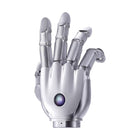
- 21 active degrees of freedom Every joint has its own motor: five in the thumb and four in each finger, including sideways spread at each knuckle.
- Direct-drive, backdrivable joints With no gearbox between motor and joint, the fingers yield to outside force, and BrainCo designs them for millisecond response and compliant, safe contact.
- 100 N grip, 20 kg payload The hand grips with at least 100 N, pinches with at least 25 N and holds 20 kg in the whole hand or 5 kg on four fingers.
- 33 grasp patterns BrainCo reports a full Kapandji opposition score and all 33 grasps of the Feix GRASP taxonomy, on objects 10 to 150 mm across.
- 0.33 s open to close Joints travel open to close in 0.33 s and repeat to 0.1° under position, MIT force-position, current, admittance or impedance control at 500 Hz.
- EtherCAT, CAN FD and RS-485 on 16–85 V Three industrial buses and a wide supply input let the hand run from a humanoid's main power rail.
- Open software stack Python and C/C++ SDKs, a ROS 2 Humble driver and URDF, MuJoCo and Isaac Sim models come with reinforcement-learning and teleoperation demos.


Description
The BrainCo Revo 3-21 Basic is BrainCo's 21-degree-of-freedom dexterous robotic hand in its base build, Revo 3 U21, without tactile sensors, made as a left or a right hand. Each of its 21 joints has its own direct-drive, backdrivable motor: five in the thumb and four in each finger, so every finger flexes at three joints and spreads sideways at the knuckle.
That joint count is what separates the Revo 3 from the 11-degree-of-freedom Revo 2. BrainCo reports a full Kapandji opposition score and all 33 grasps of the Feix GRASP taxonomy, on objects from 10 mm to 150 mm across, which opens up in-hand manipulation: turning, re-gripping and using tools rather than only closing on them. The hand grips with at least 100 N, pinches with at least 25 N, carries 20 kg (5 kg on four fingers), moves a joint from open to close in 0.33 s and repeats to 0.1°.
It is aimed at embodied-AI and humanoid research teams, universities and robot makers training manipulation policies. Control runs at 500 Hz over EtherCAT, CAN FD or RS-485 in position, MIT force-position, current, admittance or impedance mode, from a 16–85 V supply, and an IMU and a temperature sensor sit on the mainboard. BrainCo provides Python and C/C++ SDKs, a ROS 2 Humble driver, URDF, MuJoCo and Isaac Sim models, and reinforcement-learning, VLA and teleoperation demos. Core joints are rated for 1,000,000 flex cycles.
All Revo 3 versions share these specifications and differ only in sensing. The Revo 3-21 Touch (U21T) adds a 451-point pressure array, and the Revo 3-21 V-Touch (U21VT) combines a 336-point palm array with visuotactile fingertips. For a Unitree H2, see the Revo 3 U21 hand for the H2 EDU. Choose the Basic when motor position and current feedback are enough, or compare the Revo 2 range and other makers among our dexterous robotic hands.
Key Capabilities
- 21 active degrees of freedom: Every joint has its own motor: five in the thumb and four in each finger, including sideways spread at each knuckle.
- Direct-drive, backdrivable joints: With no gearbox between motor and joint, the fingers yield to outside force, and BrainCo designs them for millisecond response and compliant, safe contact.
- 100 N grip, 20 kg payload: The hand grips with at least 100 N, pinches with at least 25 N and holds 20 kg in the whole hand or 5 kg on four fingers.
- 33 grasp patterns: BrainCo reports a full Kapandji opposition score and all 33 grasps of the Feix GRASP taxonomy, on objects 10 to 150 mm across.
- 0.33 s open to close: Joints travel open to close in 0.33 s and repeat to 0.1° under position, MIT force-position, current, admittance or impedance control at 500 Hz.
- EtherCAT, CAN FD and RS-485 on 16–85 V: Three industrial buses and a wide supply input let the hand run from a humanoid's main power rail.
- Open software stack: Python and C/C++ SDKs, a ROS 2 Humble driver and URDF, MuJoCo and Isaac Sim models come with reinforcement-learning and teleoperation demos.
Buying through Robotix Market
This unit is sourced new through established distribution channels and ships worldwide with the manufacturer warranty. Technical support is coordinated with the manufacturer's own service network. Deployment scope, configuration, and commissioning responsibilities are agreed as part of the quotation — on-site installation is not included in the product price.
Official Product Videos
Features
Specs
| Brand | BrainCo |
|---|---|
| Model | Revo 3-21 Basic |
| BrainCo model code | Revo 3 U21 (Base) |
| Fingers | 5 |
| Degrees of freedom | 21, all active, each driven by its own motor |
| DoF distribution | Thumb 5; index, middle, ring and little finger 4 each |
| Joint drive | Fully direct-drive, backdrivable |
| Thumb joint ranges | CMC abduction/adduction 0–110°, CMC rotation (opposition) 0–105°, CMC flexion 0–75°, MCP flexion −10° to 90°, IP flexion −20° to 90° |
| Finger joint ranges | MCP flexion −5° to 90°, PIP −10° to 90°, DIP −20° to 90°; abduction/adduction index −10° to 30°, middle −20° to 25°, ring −25° to 20°, little −30° to 10° |
| Overall size | 216 × 108 × 50 mm |
| Weight | Confirm at quote |
| Maximum active grip force | ≥ 100 N |
| Maximum fingertip pinch force | ≥ 25 N |
| Whole-hand payload | 20 kg |
| Four-finger payload | 5 kg |
| Position repeatability | 0.1° |
| Joint open-to-close time | 0.33 s |
| Grasp diameter | 10–150 mm |
| Grasp coverage | Full Kapandji opposition score; 33 grasp patterns (Feix GRASP taxonomy) |
| Tactile sensing | None (fitted on the Revo 3-21 Touch and V-Touch) |
| On-board sensors | IMU and temperature sensor on the mainboard |
| Communication interfaces | EtherCAT, CAN FD, RS-485 (Modbus RTU, 5 Mbps by default) |
| Joint control frequency | 500 Hz |
| Control modes | Position, MIT force-position, current, admittance and impedance control |
| Supply voltage | 16–85 V (a stable 24 V DC supply rated above 100 W is recommended) |
| Maximum current | 10 A at 24 V |
| Power connector | XT30 |
| Hand side | Left or right; state the side when ordering |
| Default device ID (RS-485) | 126 left hand, 127 right hand |
| SDK | Python and C/C++ for Linux and Windows; ROS 2 Humble driver with ros2_control |
| Simulation models | URDF (ROS 1/2), MJCF (MuJoCo) and USD (Isaac Sim) |
| Firmware updates | Over the air (OTA) |
| Durability | Core joints rated for 1,000,000 flex cycles; drop, vibration, load, temperature and salt-spray tested |
| Robot mounting | Confirm at quote |
Industries
Frequently Asked Questions
The BrainCo Revo 3-21 Basic Dexterous Hand (U21) is priced at €15.600 in your market.
Twenty-one, all active, each with its own direct-drive motor: five in the thumb and four in each of the other fingers, covering flexion at three joints and sideways spread.
No. The Basic (U21) senses through its motors' position and current, plus an IMU and a temperature sensor. The Revo 3-21 Touch adds a 451-point pressure array, and the V-Touch adds visuotactile fingertips.
It grips with at least 100 N, pinches with at least 25 N and carries 20 kg in the whole hand or 5 kg on four fingers, closing a joint in 0.33 s.
Over EtherCAT, CAN FD or RS-485 with a 500 Hz control rate, on a 16–85 V supply. BrainCo supplies Python and C/C++ SDKs and a ROS 2 Humble driver; mounting to your arm or humanoid is confirmed with the quotation.
BrainCo makes the Revo 3 in both. Tell us the side you need when you order, or order one of each for a pair; the default RS-485 IDs are 126 for the left hand and 127 for the right.
Recently Viewed
You haven't viewed any products yet.